

Trailer Suspension
↵
Shandong Jinsheng Axle Manufacturing Co., Ltd
We are one of specialized enterprises in the scientific research, design, production and sale, with more than 300 skilled employees and professional designers for different areas.
Why Choose Us
Company Honor
Enterprises have passed ISO9001, ISO14001, OHS10012, OHSAS, ISO/TS116949:2009 successively Certification, the enterprise has a high quality assurance ability.
Sales Network
Our products to Southeast Asia, the Middle East, Latin America and other countries, enjoying a good reputation.
Customer Service
We prioritize open communication to address our clients' specific requirements and deliver personalized solutions.
Technical Support
Our team of experts is available to assist with troubleshooting, answer technical inquiries, and provide guidance.


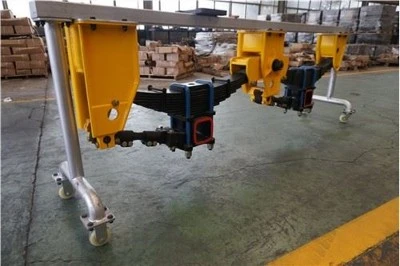


What is a Trailer Suspension Unit and How Does It Work?
For many people towing trailers of all different types such as boat trailers, caravans, camper trailers, horse boxes or light commercial trailers, a suspension is nothing more than a few bits of mechanical hardware thrown together that separates the wheels from the trailer body.
In a nutshell, a suspension unit is designed to connect the wheels (and if it is a brakes suspension unit the brakes) to the body of the trailer and whilst driving on the road they are designed to absorb the worst of any physical blows that occur from an unsmooth surface. They also must absorb the noise whilst upholding safe towing through maintaining the handling of the trailer behind the vehicle.
What type of trailer suspension units are there?
Before buying your trailer suspension unit you need to consider what your trailer is used for and the weight it will carry.
Unbraked suspension units
The two types of unbraked trailer suspension units you can choose from are unbraked suspension units without hubs and unbraked suspension units with fitted cast hubs.
Braked suspension units
For those who are towing trailers with weights of more than 750kg, you will need a braked suspension unit. We stock Avonride and Peak braked suspension units for weights of 750kg, 1300kg, 1500kg and 1800kg.
What else do I need when I buy a suspension unit?
When buying a suspension unit don't forget to buy a suspension mounting plate to attach it to your trailer. We offer both 6-hole suspension mounting plates and 8-hole suspension mounting plates. Be sure to check your unit before you purchase it to make sure you are buying the right one. We also have a range of suspension kits with all the components including hubs, bearings and caps, which you need to make as easy as possible.
If I buy a trailer suspension unit, do I need an axle?
No, you don't need an axle if you buy a suspension unit as the unit is what you mount to the trailer chassis and attach the wheels to your trailer. We also stock a wide range of braked and unbraked torsion axles. These can be purchased as an alternative to suspension units. A torsion axle is made with thick rubber concealed inside the axle's tubing.
Whilst towing your trailer each wheel moves up and down and the rubber inside the axle compresses giving an even wheel suspension for a smooth ride. A torsion axle allows each wheel to act independently to absorb any shocks from the road. Due to fewer moving parts on the torsion axle, a key benefit of it is that it requires less maintenance. All you need to do is give us the measurements for your axel and we will get it made to these specifications.
Why should I buy a new trailer suspension unit or torsion axle?
The answer is simple! Why would you purchase a new trailer when you can just upgrade your trailer suspension or torsion axle? By upgrading your trailer suspension or trailer axle you can not only increase the life of your trailer but also improve its performance. Both our suspension units and torsion axles will help you increase your trailer's ability to withstand uneven terrain or handle bumpy corrugated roads.
Types of Trailer Suspension
There are a number of choices for suspension on a trailer that is practical and enduring and while there are other options such as swing arms, coil and shock absorber style suspension available, the following are the most popular.

Leaf Springs
Leaf spring suspension has been around in one form or another since Roman times and steel leaves have been used since the 18th century. You might think that using leaf springs on your trailer is a bit old fashioned, believe me, it's not. The reason why is we still use them is because they are so damn good. They are relatively cheap to manufacture, long-lasting, easy to repair or replace and depending on the spring setup, they can carry huge loads while reducing stresses on the trailer chassis and axles.

Slipper Leaf Springs
This spring has the least moving parts of all springs although there can be a bit of wear where the springtail rubs against its slipper. An anti-rattle version is available as this spring can be very noisy over bumpy roads if the standard version is used. Using the slipper to retain the spring gives good lateral stability to the trailer and is especially good on a trailer with 2 or more axles because of this extra constraint. An advantage of these springs on a single axle is that the distance between the chassis and the spring is quite compact and can be helpful if you are after a lower deck height.

Double Eye Leaf Springs
This is another common type of setup that rather than 2 loading points on the chassis with the slipper style, the dual eye has 3 distributed points which minimize stress in the chassis and to some point to the axle. The spring requires a correct set up to ensure correct operation. I have seen these springs tuck themselves in between the hangers and jam up due to very bumpy roads and overloading of the trailer. They are ideal for single axles but due not give as good side to side stability as the slipper style on a multi-axle setup and reduces their load sharing capacity.

Parabolic Springs
The Parabolic spring is the modern version of the leaf spring. It is normally a single leaf with a thicker center tapering out to the ends in a parabolic curve. The advantages of this spring are that there is no interleaf friction, they weigh a little less than standard leaf springs and are not as stiff as leaf springs so give a much smoother ride. Disadvantages are that they tend to take a lot of room up under the trailer so this can limit how low the deck height will be and the single leaf version has a lower load capacity compared to standard leaf springs.
Trailer suspensions are comprised of springs, dampers, shock absorbers, axles and other components that link the trailer to its wheels allowing the driver to have complete control of the trailer. In addition, they dampen harmful inputs from the road (vibrations, bumps, noise), giving drivers a smoother ride while protecting the trailer and its cargo.
However, safety and control of the trailer comes at the cost of lesser ability to dampen and absorb inputs from the road. That's because the stiffness of the spring affects how the sprung mass—the mass of the trailer supported on the springs—responds. The stiffness is affected by the ratio between the sprung and unsprung mass—the weight of the axle, brake and wheel end systems. When a tire absorbs impact and bounces vertically, a loosely sprung suspension—or one where the sprung and unsprung mass are isolated—will better accept vertical movement and help dissipate the input. In that way, a high unsprung mass will dampen road input, and thus protect cargo, reduce noise and vibration and increase driver comfort.
Because of this dichotomy, suspension manufacturers have worked to achieve a balance in performance to provide driver comfort and cargo protection while maintaining safety and control of the trailer. This balance is further challenged by the fleet's need for reduced total cost of ownership (TCO), operational simplicity and overall suspension system weight to carry more freight and reduce fuel and emissions.
Besides driver comfort, fleets want to spec a trailer suspension that reduces road input in order to prolong the life of the trailer's components. Lights, doors and hinges, side walls and the suspensions itself are all affected by vibration and bumping.
Leaf springs are the simplest suspension systems as they typically don't require an air control system and shock absorbers. According to Hicks, they will work best if the trailer and its application/duty cycle allows for half to full laden conditions for most of its life cycle.
Determining type
No different from spec'ing the trailer itself, the application determines the type of suspension mounting is needed. This, in addition to capacity, will determine which suspension is required.
Air ride suspension market share for fixed frame, specialty trailers is high since the added trailer cost, application demands and customer preferences require a higher level of ride quality/cargo protection in on/off-highway applications. Off-road specialty trailers are still dominated by mechanical suspensions due to their simplicity and robustness.
Trailer Suspension – Is It Right For You?
In the ever-expanding world of trailers, ranging from recreational to industrial applications, selecting the right suspension system plays a pivotal role in ensuring safety and comfort. Whether for transporting goods or setting up a home-on-wheels, a reliable suspension system is a cornerstone of a successful journey. This article serves to guide enthusiasts and professionals alike in choosing the best suspension system for their trailers.
Before delving into the details, it is essential to grasp what a suspension system is and why it holds such significance in trailer configuration. Essentially, the suspension is the buffer between the road and the trailer, absorbing shocks and bumps to provide a smoother ride. Moreover, a robust suspension system contributes to elongating the lifespan of your trailer by reducing the wear and tear on its structure. It is typically composed of various components like springs, shock absorbers, and linkages that work collectively to ensure stability and comfort.
Choosing the right suspension system for your trailer depends largely on your specific needs and preferences. Different suspensions fare better in certain situations. For instance, if you own a utility trailer and frequently transport heavy loads, a leaf spring suspension might be your best bet owing to its load-distributing capabilities. Conversely, for luxury travel trailers, an air suspension system can provide a superior level of comfort and adjustability.
Furthermore, maintenance requirements vary between the different types. Leaf spring suspensions might demand regular check-ups to prevent rust and wear, while air suspensions generally require less frequent maintenance, owing to their modern build and technology. Cost-effectiveness is another critical aspect to consider; traditionally, leaf spring and torsion suspensions are more budget-friendly compared to the advanced and feature-rich air suspension systems.
Drawing insights from industry veterans, it is often recommended to thoroughly assess your trailer's primary usage before settling on a suspension system. Factors like frequency of use, type of terrain, and load weight play a significant role in determining the best fit. Additionally, seeking recommendations and reviews from fellow trailer owners can provide valuable insights into real-world performance of different suspension systems.
When navigating through various options, considering case studies or user experiences can offer a goldmine of information. Many trailer owners have documented their experiences with different suspensions, highlighting the noticeable benefits in different scenarios. For instance, users often praise the rubber torsion suspension for its quiet and smooth performance, especially during long-haul journeys.
Advantages of Air Suspension On Lorries and Trailers
Many new lorries and trailers come fitted with air suspension, or at least have an option to have it fitted at extra cost. Older lorries and trailers can sometimes be retrofitted, too.
Improved fuel economy
The higher your suspension is, the more the wind resistance of the lorry and trailer. Advanced air suspension systems can adjust the ride height based on the load's weight and the journey type. For long, smooth motorway journeys with light loads that don't compress the suspension as much as heavy loads, the suspension can be adjusted lower to take advantage of the reduced profile. For heavy loads, the suspension can be made as firm as required.
Reduced vibration
Reduced vibration is better for the driver and for the cargo. Long haul drivers can experience back pain due to sitting for extended periods in a vibrating truck cab. Vibration causes fatigue and discomfort, too; a smoother ride is nicer for a driver.
A smoother ride is also easier on the lorry and the trailer as it's not shaken to bits over time. Cargo carried by the lorry is less likely to be damaged (although, packaging and load restraint methods these days are very good anyway). Cargo is less likely to shift, too.
Less damage to the road
A smoother ride means less damage to the road surface, and much less vibration transmitted into roadside structures such as bridge parapets and buildings.
Improved tyre wear and handling
Less vibration and a better spread of the load through levelling results in improved tyre wear. Some air suspension can lift unused axles, extending the life of those tyres.
Suspension is a big factor in how a vehicle handles, too. Better suspension could mean less likelihood of a rollover event.
Better resale values on lorries and trailers
You're more likely to sell your lorry or trailer for a higher price with air suspension.
More versatile
A trailer can be used for more types of loads when the suspension setup is flexible. Fragile loads such as glass are less likely to be damaged. Loads with difficult weight distribution can be levelled.
Our Factory
We are one of specialized enterprises in the scientific research, design, production and sale, with more than 300 skilled employees and professional designers for different areas. We adopt the domestic and international technical standards in production, accurately grasp the information of the market demand and make quick and optimal designs. In this way, our axle, suspension and other fittings have the world-class technical quality through reasonable and advanced manufacture technologies.

FAQ
We're well-known as one of the leading trailer suspension manufacturers and suppliers in China for over 20 years. If you're going to wholesale high quality trailer suspension with competitive price, welcome to get more information from our factory.